Book

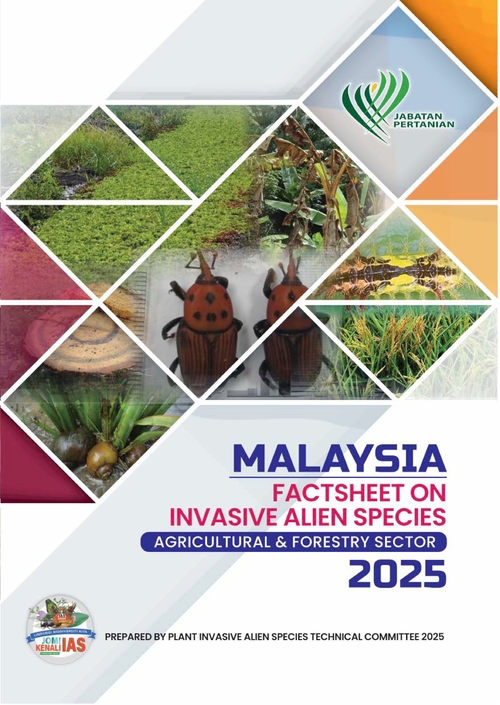
MALAYSIA FACTSHEET ON INVASIVE ALIEN SPECIES AGRICULTURAL & FORESTRY SECTOR

QR Code
Scan QR code for mobile experience
Download QR:
  • 2025
  • Publisher
    Department of Agriculture, Ministry of Agriculture and Food Security
  • Country
    Malaysia
  • Language
    English
  • ISBN
    9789830473499

Abstract

Invasive Alien Species (IAS) are non-native organisms that spread beyond their natural range and cause harm to the environment, economy, and society. IAS on plant pose a significant threat to Malaysia’s rich biodiversity and ecosystems. These non-native species, introduced either accidentally or intentionally, can disrupt local ecosystems, harm native species, and impact agriculture, forestry, and fisheries. Malaysia, with its diverse ecosystems ranging from tropical rainforests to coastal areas, is particularly vulnerable to the negative impacts of invasive species due to its high level of international trade, tourism, and agriculture.

The introduction of IAS can result in the displacement of native flora and fauna, causing long-term ecological damage. IAS such as Salvinia molesta, Rhynchophorus ferrugineus and Bacterial Panicle Blight, are just a few examples of organisms that have caused harm to Malaysia's natural environment. They often outcompete local species for resources, alter habitats, and contribute to the decline of indigenous species, some of which are already threatened or endangered.

Their introduction whether accidental or deliberate has far-reaching consequences. The impact of IAS on a country can be assessed through several criteria. These include ecological, economic, and social dimensions, as well as the availability and effectiveness of management strategies.

The impacts of IAS are observed across three primary impacts, which are environmental, economic and social.

  1. Environmental impacts
    IAS can have profound, cascading and far-reaching impacts on environment, often leading to significant changes in ecosystems, biodiversity, and natural processes. Their ability to alter biodiversity, disrupt ecosystem functions, and change the structure of habitats can lead to the degradation of ecosystems and the loss of valuable ecosystem services. Effective management and control of IAS are critical for maintaining ecological balance and ensuring the resilience of native ecosystems.
     
  2. Economic impacts
    IAS can have significant economic impacts across multiple sectors, leading to direct and indirect costs. These impacts can affect industries, agricultural production, tourism, infrastructure, and public health. The economic impact of IAS is multifaceted and can be quite severe. From direct costs like crop damage and infrastructure repair to indirect effects on industries like tourism and fisheries, the financial burden of IAS can be substantial. Effective management and early detection are critical to reduce these economic costs. Addressing the issue of IAS involves a combination of preventive measures, control programs, and restoration efforts to mitigate their long-term economic impacts.
     
  3. Social impacts
    The social impacts of IAS can be significant and wide-ranging, affecting communities, livelihoods, public health, and cultural practices. These impacts can alter the quality of life for individuals and societies, especially those living in or dependent on ecosystems that are affected by IAS. The social impacts of IAS are multifaceted, affecting public health, livelihoods, cultural practices, and community well-being. The effects can be particularly severe for vulnerable populations who are heavily dependent on natural resources and less able to cope with the economic or environmental disruptions caused by IAS. Addressing these social impacts requires not only effective environmental management strategies but also public engagement, community support, and policies that consider the social dimensions of IAS.
     

This IAS Fact Sheet of Plant aims to highlight the major IAS in Malaysia, their impacts on local biodiversity and ecosystems, and the management strategies to control and manage their spread. Effective management strategies, including prevention, eradication, containment and control, are crucial for preserving Malaysia’s unique natural heritage and preventing further ecological degradation caused by IAS. While IAS pose a severe challenge to ecosystems and economies worldwide, concerted global efforts and effective management strategies can help mitigate their impacts and protect native biodiversity.

 

Citation

MALAYSIA FACTSHEET ON INVASIVE ALIEN SPECIES AGRICULTURAL & FORESTRY SECTOR, 2025. Department of Agriculture, Ministry of Agriculture and Food Security, Malaysia.
Back to top
Today, there are less than 200 Malayan tigers left in our country.
#SaveOurMalayanTiger. Visit harimau.gov.my
Malaysia Biodiversity Information System (MyBIS)   by   Malaysia Biodiversity Centre (MBC)


Copyright © 2026, Malaysia Biodiversity Centre (MBC), Ministry of Natural Resources and Environmental Sustainability (NRES). All rights reserved. DISCLAIMER - The Malaysian Government, Ministry of Natural Resources and Environmental Sustainability (NRES), Malaysia Biodiversity Centre (MBC) and Forest Research Institute Malaysia (FRIM) shall not be liable for any loss or damage caused by the usage of any information obtained from this website. By entering this site, you acknowledge and agree that no portion of this site, including but not limited to names, logos, trademarks, patents, sound, graphics, charts, text, audio, video, information or images are either MyBIS property or the property permitted by third-party and shall not be used without prior written approval from the owner(s).
Best viewed using latest Mozila Firefox, Google Chrome and Internet Explorer 10 with Resolution 1024 x 768px or above. Version 2.0 / 2016
Website Citation: MyBIS (2026). Malaysia Biodiversity Information System. Published on the Internet https://www.mybis.gov.my/, Ministry of Natural Resources and Environmental Sustainability, Malaysia Biodiversity Centre & Forest Research Institute Malaysia. [Retrieved 05 June 2026].